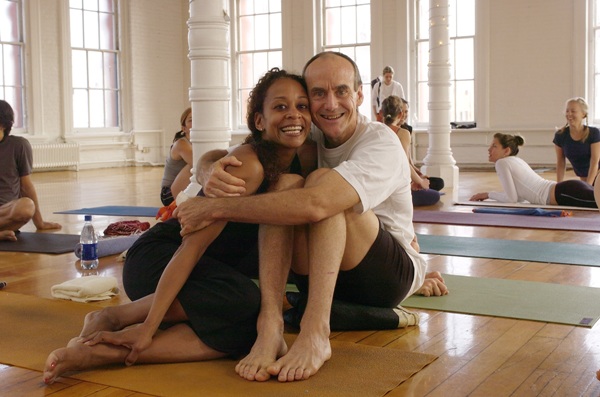
David Swenson & Shelley Washington are back in Milan! Whoop Whoop!
They are hosting an Ashtanga Yoga Workshop from Friday May 30th to Friday June 6th 2014 at the Yoga Shala in via Domenichino 11, Milan Italy.
From May 30th to June 2nd the workshop is open to beginners and advanced students, whilst from June 3rd to Friday 6th the workshop is open to those that know the sequins as it’s Mysore style only.
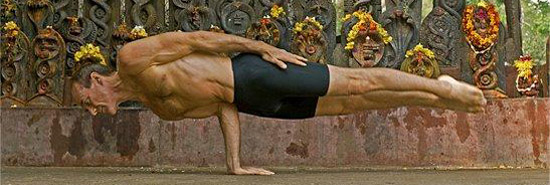 David is one of the most famous Ashtanga Yoga teachers in the world. He travels the globe bringing knowledge of this ancient practice with him. HIs experience spans over 20years. His approach is light and deep, authentic and immediate and his ability to convey leads straight to the heart of the student.
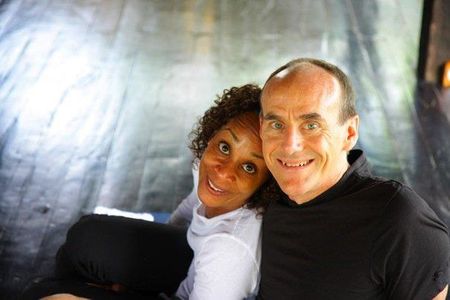
David will be accompanied by his wife Shelley. A professional dance, she approaches Ashtanga Yoga after meeting David and begins her journey with frequent travels to Mysore to study with Sri. K Pattabhi Jois. Following David in his teaching, Shelley has developed an incredible ability to listen to the students, with a sensitivity tuned to their needs by creating rare empathy as well as sending an addictive sympathy!
David & Shelley are a couple of great beauty and a great example of how yoga can bring harmony into one’s life.
Schedule:
FRIDAY MAY, 30
6-8 pm DAVID & SHELLEY’S INTRODUCTION
ASHTANGA YOGA, AN INTRODUCTION: exploring the fundamentals
SHORT LED PRACTICE FOR ALL
SATURDAY, MAY 31
7:15-9:15 a.m. LED PRIMARY SERIES (for advanced students)
9:30-11:30 a.m.LED HALF PRIMARY SERIES UP TO NAVASANA (for beginners)
3-5 p.m. ASHTANGA YOGA: Inside and Out – a journey from the gross to the subtle energies
5:15-6:15 pm BANDHA
SUNDAY, JUNE 1
7:15-9:15 a.m. LED PRIMARY SERIES (for advanced students)
9:30-11:30 a.m. LED HALF PRIMARY SERIES UP TO NAVASANA (for beginners)
3-5 p.m. INVERSION, BACKBENDS AND SITTING BREATH: finding stability when the world is invertedand returning home to breath
5:15-6:15 p.m. PRANAYAMA
MONDAY JUNE, 2
6:30-10:00 a.m. MYSORE STYLE (for students who know the sequence)
10:30-12:30 a.m. LED HALF PRIMARY SERIES UP TO NAVASANA (for beginners)
3-5 p.m. THE PHYSICS OF FLIGHT AND FLOW THROUGH THE PRACTICE: exploration the realms ofVinyasa (breath and movement coordination)
5:15-6:15 p.m. YOGA AND LIFE, FROM MAT TO RELATIONSHIPS: an experiential journey through the AshtangaYoga of Patanjali
MYSORE STYLE
FROM TUESDAY 3rd TO FRIDAY 6Tth of JUNE
from 6,30 a.m. MYSORE STYLE
(The starting time of the Mysore Style may vary depending on the number of participants. Preference will be given to those who work).
PRICES: given the vastness of the program and the various possibilities of frequency that will be required, the costs will vary depending on the classes which will be attended. From experience we know that the chances of participation in events like these can be different, so we tried to predict the various combinations of price to meet a certain proportion. Of course the policy is dictated by the fact that those who make the entire seminar pays less in proportion.
EARLY BIRD BEFORE MAY 8
All Workshop from Friday May, 30 to Friday June 6th €300
Intensive Long Weekend from Friday May, 30 to Monday June 2nd €230
Weekend two days 160€
Full Day Saturday May 31 or Sunday June 1 or Monday June 2 €85
Only Afternoon Saturday May 31 or Sunday June 1 or Monday June 2 €55
Single practice €35
Two practices €70
Three Practices €100
Four Practices €130
Five Practices €150
PAYMENT AFTER MAY 8
All Workshop from Friday May, 30 to Friday June 6th €320
Intensive Long Weekend from Friday May, 30 to Monday June 2nd €250
Weekend two days 180€
Full Day Saturday May 31 or Sunday June 1 or Monday June 2 €95
Only Afternoon Saturday May 31 or Sunday June 1 or Monday June 2 €65
Single practice €40
Two practices €80
Three Practices €110
Four Practices €140
Five Practices €160
To attend the workshop, membership to the ASSOCIATION MI.AS.YO. MILANO ASHTANGA YOGA is required, and it is valid for the academic year 2013-2014; this provides insurance coverage and the opportunity to participate in all the activities organized by the Association during the year: the cost is 15€.
I’m definitely going to the entire thing – what about you? This is an incredible opportunity NOT to be missed! 🙂
Posted in Ashtanga Vinyasa Yoga, Ashtanga Yoga, Corsi di yoga a Milano, Milano Italy, workshop, Yoga Dinamico
|
Tagged ashtanga, Ashtanga Yoga, ashtanga vinyasa, ashtanga vinyasa yoga, ashtanga workshop, ashtanga yoga, David, david swenson, david swenson in milan italy, Elena de Martin, la yoga shala, shelley washington, via domeni, via domenichino
|
Day 4 was set up into practice in the morning and then Chanting-Lecture-Yoga Therapy in the afternoon. And what an afternoon it was! By the end of it my head was buzzing…buzzing with so much info! All this philosophy i had already covered in my Ashtanga Vinyasa TTC in Rishikesh India, but it’s ALWAYS good to go over it again, and again, and again….it needs to sink in, and since it’s so different to what we are used to, it takes time.
We bagan by singing the Shakti Mantra followed by 3 rounds of Anuloma Viloma (alternate nostril breathing).
The next Mantra we sang is the Durga Mantra:
“Om Dum Durgayai Namaha” and we sang this 108 times at the end we sat in silence for a few mins.
We then sang a sacred mantra, a divine mantra – i don’t have the name, it’s so sacred & divine that it’s name is a secret! 😉
Bija – literally means seed – used for mystical “seed syllables” contained within Mantras. These seeds do not have precise meanings, but are thought to carry connections to spiritual principles. The best-known bīja syllable is Om.
It is said that when you repeat a Bija Mantra a certain amount of times, the energy of that Mantra will grow – sounds pretty cool huh? There is a catch: you have to repeat it 400,000 times before it’s energy starts to grow!
For example, the triangles in a Yantra are seeds of potential energy, when you chant a bija regularly, the energy grows in the field of consciousness.
You can sing a simple bija – Om Gam Ganapataye Namaha or Om Dum Durgayai Namaha. Eddie then gave us the example of the Gayatri Mantra and said that each bija each syllable must be sang a certain amount of time. He also told us that Brahmin’s had to repeat 1million bija’s and that they started at the tender age of 7 by repeating the bija 108 times a day, 3 times a day – this meant that one would finally finish at the age of 45!
This just goes to show that the spiritual evolution in India has a long evolution.
“How long does it take for a dove with a piece of silk in it’s mouth to wear down a rock that rises from the sea level?” – it doesn’t matter, just need to know that it takes a long time!
Bhagavad Gita ch.6 – Arjuna asks Krishna “When was the 1st Karma started?” Krisna’s answer? “The web of Karma is unfathomable, it can’t be known”
Suffering is beginning less, but it has an end (that’s good to know!)
When & Why questions are based on Space & Time – the answer satisfies for a temporary period.
Thru the practice you get your own inner understanding and little by little doubts will go away. (Eddie told us that Guruji didn’t believe in the word question, and that to him, questions were just doubts.)
What are the different ways one can gain knowledge from a wise person (Sage or Guru)?
– questioning
– surrendering
– service (prostrate)
Back to Bija’s & Mantras 😉
Then we sang the “Om Aim Hreem Kleem Chamundaye Vichche” Mantra either 27 or 54 times (not 100% sure) followed by silence.
Then we did 3 rounds of alternate nostril breathing on our own – as we inhaled & as we exhaled we mad to mentally repeat the mantra Om Aim Hreem Kleem Chamundaye Vichche” (this was actually really nice).
Then we moved on to the lecture part of the afternoon. The topic was Asanas: Yoga Poses.
We addressed 3 questions:
1. How are Asanas related to spirituality?
2. Is Yoga physical or spiritual?
3. Is Yoga religious?
4. Who owns Yoga?
We began with Samkhya – there are 25 things postulated about Samkhya, 2 eternal thing.
A postulation is an educated assumption about something based on observation and experience but you don’t know it to be true or not. It’s a way of explaining something that you think is true, but not necessarily sure.
Postulations in India Philosophy have been upheld for a long time (1,500-5000years), as time goes by, adjustments are made, but initial idea remains.
The India/Vedic tradition is an oral tradition.
Samkhya is an enumerationist philosophy & regards the universe as consisting of two realities:
1. Consciousness – pure awareness (doesn’t create anything or do anything, but is eternal), power of seeing & beingness
2. Nature – infinite creativity (created & is eternal), power of becoming).
Within Nature there are 3 qualities: the 3 Gunas: Satva, Tamas, Rajas (rope like quality) – 3 ropes intertwining in infinite ways, energetic patterns of everything .
3 things happening:
1. Observing/Observer
2. Process of Observing
3. Object of Observation
Ahamkara – Cosmic I-ness
Satvic – harmony, pure, poise, fineness, lightness, illumination, and joy;
Tatmasic – coarseness, heaviness, obstruction, and sloth;
Rajasic – dynamism, activity, excitation, and pain;
Eddie then gave us an example to better understand the 3 Gunas:
Take a candle -> all 3 gunas are represented in 1 object = in all the universe
– the wax is inert (tamasic – heavy, won’t move unless you move it)
– then we have the wick
– then the flame, the fire (rajasic – activity)
– warmth & light coming from the candle (satvic – warm, bright, light, nice)
Our Body:
– bones are tamasic
– nervous system (electric impulses) is rajasic
– mind – principle of Satva (quality of reflection)
Tamasic – 5 elements (Pancha Mahabhuta): earth, water, air, fire, ether
5 Tanmatras: hearing, tasting, smelling, seeing, touching
Satva – 5 organs of Perception: eyes, ears, noce, tongue, skin
linked to element + potential (smelling – earth – nose)
5 organs of Action: locomotion legs, arms, mouth, procreation, evacuation (how we move about in the world)
linked to element + potential
Raja – nothing! It’s the Spark which brings about activity between the two – it’s the spark which brings everything to life!
So that we can know ourselves – this whole model in yoga & Samkya is to understand how we look at things.
We have:
Senses – Physical visible world – mind
1. manas 2. ahamkara (self identity) 3. intellect
underlying all this
Jiva -> higher self (universal self) Purusha (where we started)
How is this related to Yoga you may ask?
Yoga came out of this larger philosophical system
What are Yoga asanas? This question was asked to Krishnamacharya – realise link between individual soul &universal soul – yoga s union
union of the individual self + mind
Yoga is both physical & spiritual depending on your perspective of the universe.
There are different ways/levels to approach asanas:
1. Physical exercise
2. Refined physical exercise
3. Mental exercise
4. Spiritual practice
5. Spiritual experience
6 things bring success in Yoga:
– Enthusiasm
– Courage/Boldness
– Sense of Adventure
– Faith that what you’re doing is good/Conviction
– Faith/Belief in Teacher’s word
– Don’t spend time with people that pull you away from practice
In Yoga as a Physical Exercise you need Enthusiasm, Determination, Patience. You will gain flexibility, strength & reduced fat, but there can be adverse effects too. If you do anything for a purely physical reason, you take more risks, you do things that are prob not very intelligent – pure physicality is fun (i.e. skydiving) but quite often stupid [here he tells us a story of how he got injured skating].
We should recognise this in our practice – this cuts out other possibilities.
In Refined Physical Exercise, we are still doing things in a physical way, but we think of other aspects: body, organs, health. Qualifications needed: concentration on breath + guidance (qualified teacher to guide) + determination + Patience + Enthusiasm.
We get the same results are Physical Exercise + preventative health care, address existing diseases, ensure proper functioning of physiological system.
There are 3 qualities to consciousness: Satchidananda
Truth – consciousness – being
Truth – consciousness – beauty
Infinite creativity expresses itself thru all manifestations in the world. express thru truth – being – beauty.
Posted in Ashtanga Vinyasa Yoga, Ashtanga Yoga, Corsi di yoga a Milano, ctyoga, inspirational, Milano Italy, workshop, Yoga Dinamico
|
Tagged Ahamkara, beauty, bijas, consciusness, Durga Mantra, eddie stern, Eddie Stern Ashtanga Workshop in Milan Italy, Elena de Martin, Gayatri Mantra, india, la yoga shala, mantras, Milan Italy, Om Aim Hreem Kleem Chamundaye Vichche, potential energy, rajas, repetition, Rishikesh India, samkhya, satchidananda, satva, tamas, the 3 gunas, truth, via Domenichino 11, Yoga asanas, Yoga Poses
|
Yesterday was Mysore style in the morning at 6.30am…i think my body at this point was quite tired…not sure if it was tired or the late meal i had the night before, but my body felt stiff and heavy! SO still & heavy…took a while to loosen up….normally after the 10 suryanamaskars i’m loose, but this time i believe i didn’t loosen up till seated postures, can’t remember which tho.
This time i made it on time to the afternoon session – phew – decided to take the metro instead 🙂 In the afternoon we did the Ganesha Puja, unfortunately i won’t be able to tell fully how the entire afternoon went as i had to leave 30mins earlier (had to run off to teach a class) so here is what we did:
We started off the proceedings by singing the Shanti Mantra (Sahana Vavatu), then we sang the Ganesha Mantra, followed by some pranayama: 5 rounds of Surya Bhedan & 5 rounds of Chandra Bhedan. We sang “Om Gam Ganapataye Namaha” another 108 times and again 5 rounds of Surya Bhedan & 5 rounds of Chandra Bhedan. We then placed one palm over the other, rubbed the palms together creating heat, and then placed the warm palms over our faces – this is good for the nervous system, we are warming the facial nervous system which in turn affects the brain and in turn the rest of the body.
Puja means to worship.
The following are notes i took frantically trying to write down everything Eddie said, some might make some sense, i’m sure some won’t, let’s see shall we? 🙂
Advaita Vedanta – absolute pure consciousness has no name, no form, no dimension – cannot be known by mind or intellect or body.
It’s difficult to experience something that is nowhere and everywhere at the same time. We must focus the mind at 1 place at 1 time. This is where Tristana comes in – Asana/Breath/Drishti – working on the physical body, nervous system & mind. When all 3 cooperate at the same time, we have a state of attention – we can direct it wherever we like.
First we must localise the awareness. Right now our awareness is fragmented.
Body – Nervous System – Mind
3 Bodies – Physical Body
Subtle Body:
– Prana (energy + breath)
– Manas (mind – memory, thoughts, feelings, emotions)
– Buddhi (intellect – faculty of discrimination)
Causal Body:
– Body of Bliss – our Karmas, our hopes, dreams, imagination, purpose born into this life, things we feel & sense (not defined)
This is not the first time we’ve done yoga – Bhagavad Gita: “by contact in a previous life, we again have contact in this life”
That pattern in our Causal body
– Mythology & Archtypes that we find in different traditions we find around the world
Archtype is shared consciousness, as Carl Young called it: “Collective Consciusness”
We are all sharing this collective impulse toward love, happiness, goodness, etc.
– Level where all apparent diversities dissolve in unity.
All these things are locked in our practice.
The intellect decides things all the time – it thinks it’s special & that it knows best, better than all. We start to second guess – we stop listening to our intuition & the natural needs of our body: i.e. going to bed when the sun goes down, or eating when hungry -> when the body needs it.
The Body is nature – we ignore what the body needs & listen to the intellect. The intellect is just a tool to understand perception, it’s a sort of filing system.
How do we go past the intellect? -> Devotion & Surrender.
Surrender the idea “I know Best” & open up to possibilities & not-knowing. In that Not-Knowing space things happen in our hearts: gratitude, appreciation, worries disappear, stress is less & grace flows.
These are encouraged doing Puja – we surrender thru offerings – it’s an expression of Love. Purity of offering creates an open space in our Hearts.
Why then is doing Puja so complicated?
Same reason why we have many asanas, we need to have a place to bring awareness to develop it.
Guruji compared each asana to a mala, and the breath to the thread that united all the malas – practice is like sowing.
Thru the practice we engage our awareness in the present moment, each time we do an asana.
Puja is the opportunity to express devotion & surrender.
Why 3 Bodies? 3 bodies of the Devas:
Shape – physical
Subtle body – yantra (geometri diagram of energy pattern)
Nadi’s are our personal geometric diagrams (we have 72,000 nadir’s in our bodies, energy channels thru which prana flows).
What is the causal body of a Deity? Mantra
A Mantra brings the energy of a Deity to life – energy is installed thru yantra & mantra.
Tantra – to weave, when we weave – there’s form
Mantra expresses itself as a yantra
Yantra expresses itself as a Deity.
We are an expression of an energetic pattern with particular purpose. What is that purpose? That is for each of us to find out.
Simple Puna of 16 steps – Shodasha Pachara (16 offerings):
1. Stating our intention
for the removal of all stains from our consciousness (Karma leaves a mark – good & evil is arbitrary)
[Eddie here then told us the story of the Ramayana and said that we must all read it – it is now on my reading list!]
….and then i had to leave! But not to worry, in another post i’ll tell you what the other 15 steps of a simple Puja are!
OK now off to day 4.2: Chanting-Meditation-Yoga Therapy!
Ciao!
Posted in Ashtanga Vinyasa Yoga, Ashtanga Yoga, Corsi di yoga a Milano, ctyoga, inspirational, Milano Italy, workshop, Yoga Dinamico
|
Tagged ashtanga yoga, Buddhi, Causal Body, eddie stern, Elena de Martin, karma, la yoga shala, Manas, Physical Body, Ramayana, Subtle body, via Domenichino 11
|
After what seemed like forever, 1h & 15min stuck in number-to-bumper traffic, i finally got to the Yoga Shala (30mins late) and what i managed to catch of the afternoon Meditation-Pranayama-&-Chanting Session was the following….well more like Pranayama-&-Chanting session, because i was late i practically missed the whole Meditation session!
Pranayama: we did some rounds of Surya Bhedan followed by some rounds of Chandra Bhedan – don’t ask me how many rounds as i didn’t keep count, tho Eddie did suggest doing 5 of each….we then sang the Ganesha mantra a whopping 108 times, yes 108 times…why 108? The number 108 is a sacred number – i’ll write about this another time….below is the mantra repeated 108 times, just like we did 🙂
“Om Gam Ganapataye Namaha, Om Gam Ganapataye Namaha, Om Gam Ganapataye Namaha, Om Gam Ganapataye Namaha, Om Gam Ganapataye Namaha, Om Gam Ganapataye Namaha, Om Gam Ganapataye Namaha, Om Gam Ganapataye Namaha, Om Gam Ganapataye Namaha, Om Gam Ganapataye Namaha, Om Gam Ganapataye Namaha, Om Gam Ganapataye Namaha, Om Gam Ganapataye Namaha, Om Gam Ganapataye Namaha, Om Gam Ganapataye Namaha, Om Gam Ganapataye Namaha, Om Gam Ganapataye Namaha, Om Gam Ganapataye Namaha, Om Gam Ganapataye Namaha, Om Gam Ganapataye Namaha, Om Gam Ganapataye Namaha, Om Gam Ganapataye Namaha, Om Gam Ganapataye Namaha, Om Gam Ganapataye Namaha, Om Gam Ganapataye Namaha, Om Gam Ganapataye Namaha, Om Gam Ganapataye Namaha, Om Gam Ganapataye Namaha, Om Gam Ganapataye Namaha, Om Gam Ganapataye Namaha, Om Gam Ganapataye Namaha, Om Gam Ganapataye Namaha, Om Gam Ganapataye Namaha, Om Gam Ganapataye Namaha, Om Gam Ganapataye Namaha, Om Gam Ganapataye Namaha, Om Gam Ganapataye Namaha, Om Gam Ganapataye Namaha, Om Gam Ganapataye Namaha, Om Gam Ganapataye Namaha, Om Gam Ganapataye Namaha, Om Gam Ganapataye Namaha, Om Gam Ganapataye Namaha, Om Gam Ganapataye Namaha, Om Gam Ganapataye Namaha, Om Gam Ganapataye Namaha, Om Gam Ganapataye Namaha, Om Gam Ganapataye Namaha, Om Gam Ganapataye Namaha, Om Gam Ganapataye Namaha, Om Gam Ganapataye Namaha, Om Gam Ganapataye Namaha, Om Gam Ganapataye Namaha, Om Gam Ganapataye Namaha, Om Gam Ganapataye Namaha, Om Gam Ganapataye Namaha, Om Gam Ganapataye Namaha, Om Gam Ganapataye Namaha, Om Gam Ganapataye Namaha, Om Gam Ganapataye Namaha, Om Gam Ganapataye Namaha, Om Gam Ganapataye Namaha, Om Gam Ganapataye Namaha, Om Gam Ganapataye Namaha, Om Gam Ganapataye Namaha, Om Gam Ganapataye Namaha, Om Gam Ganapataye Namaha, Om Gam Ganapataye Namaha, Om Gam Ganapataye Namaha, Om Gam Ganapataye Namaha, Om Gam Ganapataye Namaha, Om Gam Ganapataye Namaha, Om Gam Ganapataye Namaha, Om Gam Ganapataye Namaha, Om Gam Ganapataye Namaha, Om Gam Ganapataye Namaha, Om Gam Ganapataye Namaha, Om Gam Ganapataye Namaha, Om Gam Ganapataye Namaha, Om Gam Ganapataye Namaha, Om Gam Ganapataye Namaha, Om Gam Ganapataye Namaha, Om Gam Ganapataye Namaha, Om Gam Ganapataye Namaha, Om Gam Ganapataye Namaha, Om Gam Ganapataye Namaha, Om Gam Ganapataye Namaha, Om Gam Ganapataye Namaha, Om Gam Ganapataye Namaha, Om Gam Ganapataye Namaha, Om Gam Ganapataye Namaha, Om Gam Ganapataye Namaha, Om Gam Ganapataye Namaha, Om Gam Ganapataye Namaha, Om Gam Ganapataye Namaha, Om Gam Ganapataye Namaha, Om Gam Ganapataye Namaha, Om Gam Ganapataye Namaha, Om Gam Ganapataye Namaha, Om Gam Ganapataye Namaha, Om Gam Ganapataye Namaha, Om Gam Ganapataye Namaha, Om Gam Ganapataye Namaha, Om Gam Ganapataye Namaha, Om Gam Ganapataye Namaha, Om Gam Ganapataye Namaha, Om Gam Ganapataye Namaha, Om Gam Ganapataye Namaha”
Ganesh is the elephant headed deity, who is widely revered as the Remover of Obstacles and the Lord of Beginnings.
Anyway, getting back to yesterday’s session, after singing Ganesha’s mantra 108 times, we sat in silence for 2mins & allowed the vibrations of the mantra to flow all around the room and thru us….then we sang the Ashtanga closing mantra, and lastly we had a few mins of Q&A with Eddie Stern….
Someone asked him about the Surya and Chandra pranayama, if they had to be together all the time (no they do not), Surya can be done on its own, it’s often done with other types of pranayama, i.e. anuloma viloma (also known as Nadi Shodan or alternate nostril breathing). An idea order of things could be starting with:
Meditation prayer
Pranayama
Japa
Pranayama
then Meditation – at this point the mind should be calm
There was another question on using mantras during practice – which is possible but then changes the type of practice. What mantra you choose will also determine the length of breath, so make sure you can breathe that long!
The usual practice we do in Ashtanga establishes awareness in the present moment with the aid of Asanas-Breath-Drishti, however if we practice with a mantra it becomes more of a Devotional practice – we just need to be aware of the difference.
And then the last question was as follows: “The importance of being Vegetarian?” – Eddie asked Why is it important or how is it important…and they asked him to answer both.
There are different levels of why being vegetarian, eating fish/chicken can be unhealthy (clogging of arteries etc), high levels of mercury in fish, industrial meat – the way animals are treated, ecological reasons (forests destroyed to breed cattle, more water is used), methane gas released from cows causes more pollution than cars, overall damage to the ecosystem, there’s also ecological considerations to take & considerations on our mind.
The food we eat has an affect on our mind – meat + alcohol dull our sense perceptions, so if we are trying to purify we need to eat food that’s helpful.
However, there is bad vegetarian food – a vegan diet is more philosophical than for health reasons. Eddie also went on to say that not all Sages were Vegetarian either….so moral of the story? Eat what is good for your body.
Posted in Ashtanga Vinyasa Yoga, Ashtanga Yoga, ayurveda, health, inspirational, nutrition, wellbeing, workshop
|
Tagged 108, alternate nostril breathing, amendola, anuloma viloma, ayurveda, chandra bhedan, chanting, Eddie Stern Ashtanga Workshop, Eddie Stern in Italy, Eddie Stern in Milan, Eddie Stern workshop, Elena de Martin, Gam, ganesha mantra, importance of being vegetarian, japa, la yoga shala, mala, mantra, meditation, nadi shodana, om gam ganapataye namaha, pranayama, surya bhedan, via Domenichino 11
|

 David is one of the most famous Ashtanga Yoga teachers in the world. He travels the globe bringing knowledge of this ancient practice with him. HIs experience spans over 20years. His approach is light and deep, authentic and immediate and his ability to convey leads straight to the heart of the student.
 christiane